About the Journal
The Anti-Trafficking Review is the first open access, peer reviewed journal dedicated to the issue of human trafficking. It explores trafficking in its broader context and intersections with gender, labour, and migration.
Each issue relates to an emerging or overlooked theme in the field of human trafficking. The Review’s focus is global in nature, exploring micro and macro levels of anti-trafficking responses and the commonalities, differences, and disconnects in between.
The journal contributes to the achievement of the Sustainable Development Goals, in particular Goal 5 (Gender Equality), 8 (Decent Work and Economic Growth) and 16 (Peace, Justice and Strong Institutions).
Current Issue
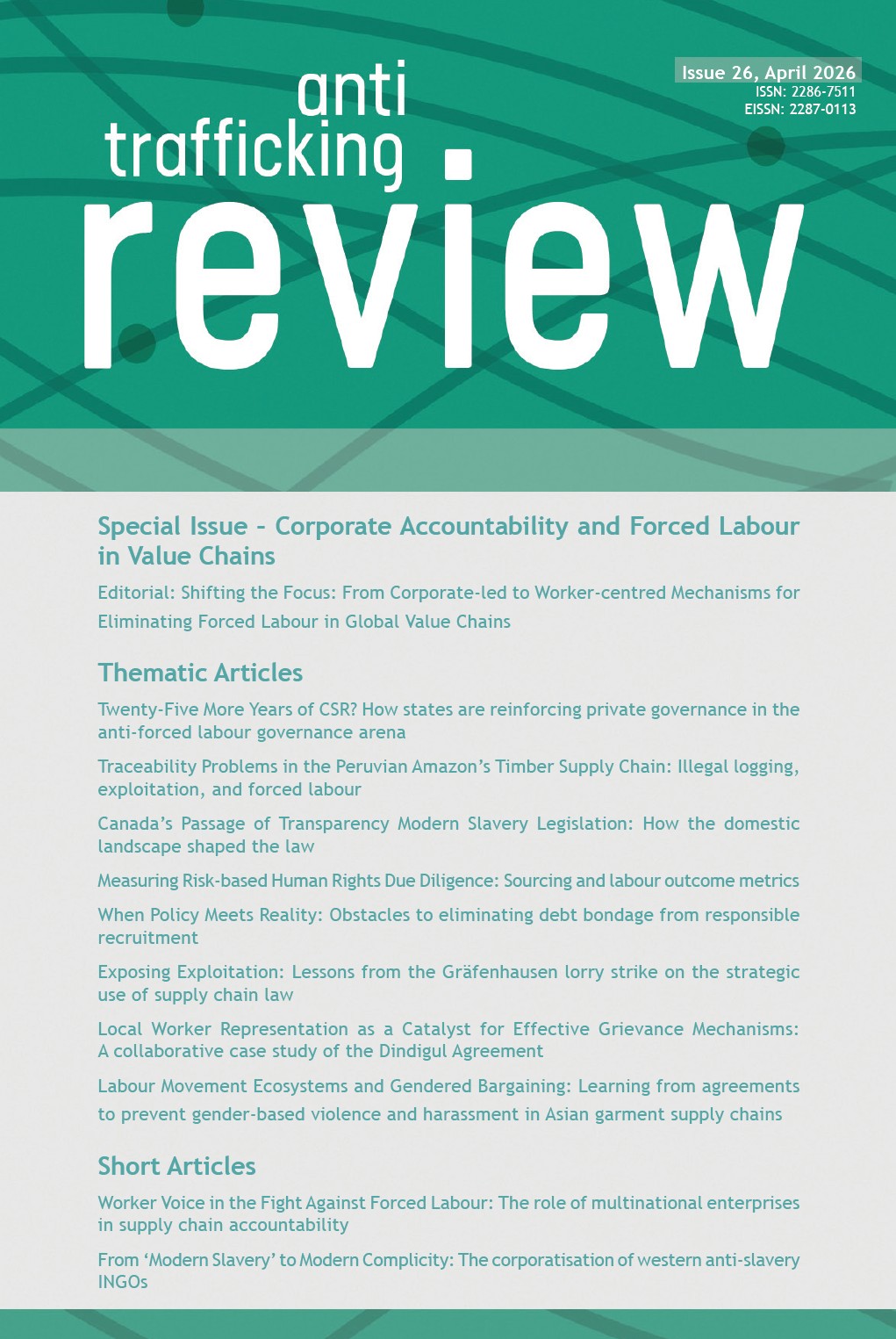
Guest Editor: Judy Fudge
This Special Issue of Anti-Trafficking Review examines recent efforts to hold multinational corporations accountable for human rights harms, including forced labour, resulting from their business practices. Contributions from across Asia, Europe, and the Americas analyse various aspects of the shift from voluntary corporate social responsibility measures to legally required or legally enforceable initiatives to address forced labour in global value chains. They interrogate the effectiveness of recently adopted transparency and human rights due diligence legislation across many Global North countries and demonstrate that worker-driven social responsibility, and other bottom-up initiatives, are better placed to reduce exploitation in supply chains than top-down state- and corporate-led approaches.
Articles
Short articles
Forthcoming Special Issues:
- September 2026: 'Care Work, Intimate Labour, Migration, and Exploitation'
- April 2027: 'Engaging Impacted Communities' (call for papers)
- September 2027: 'Solidarities Beyond Silos' (call for papers)
The Review is covered by the following abstracting and indexing services:
- Ulrich’s
- Ebsco Host
- Web of Science
- Scopus
- eGranary
- e-journals.org
- ProQuest
- Google Scholar
- Science Open
- CNKI Scholar
The Anti-Trafficking Review is published by the Global Alliance Against Traffic in Women (GAATW), an alliance of over 100 NGOs worldwide focused on advancing the human rights of migrants and trafficked persons.
'a journal that is seeking to move things forward through new ideas and a genuine commitment to dialogue' - Anne T. Gallagher, Independent scholar and legal advisor
'The Anti-Trafficking Review is clear about the current issues, the complications of the subject and contemporary global dialogues--it is leading versus following and recording. That is a REAL strength of your journal.' - Cathy Zimmerman, London School of Hygiene and Tropical Medicine
'The Review is a platform for academics and practitioners, providing a space in which practitioners have the chance to influence the academic thinking around trafficking and vice versa.' - Nicola Piper, University of Sydney