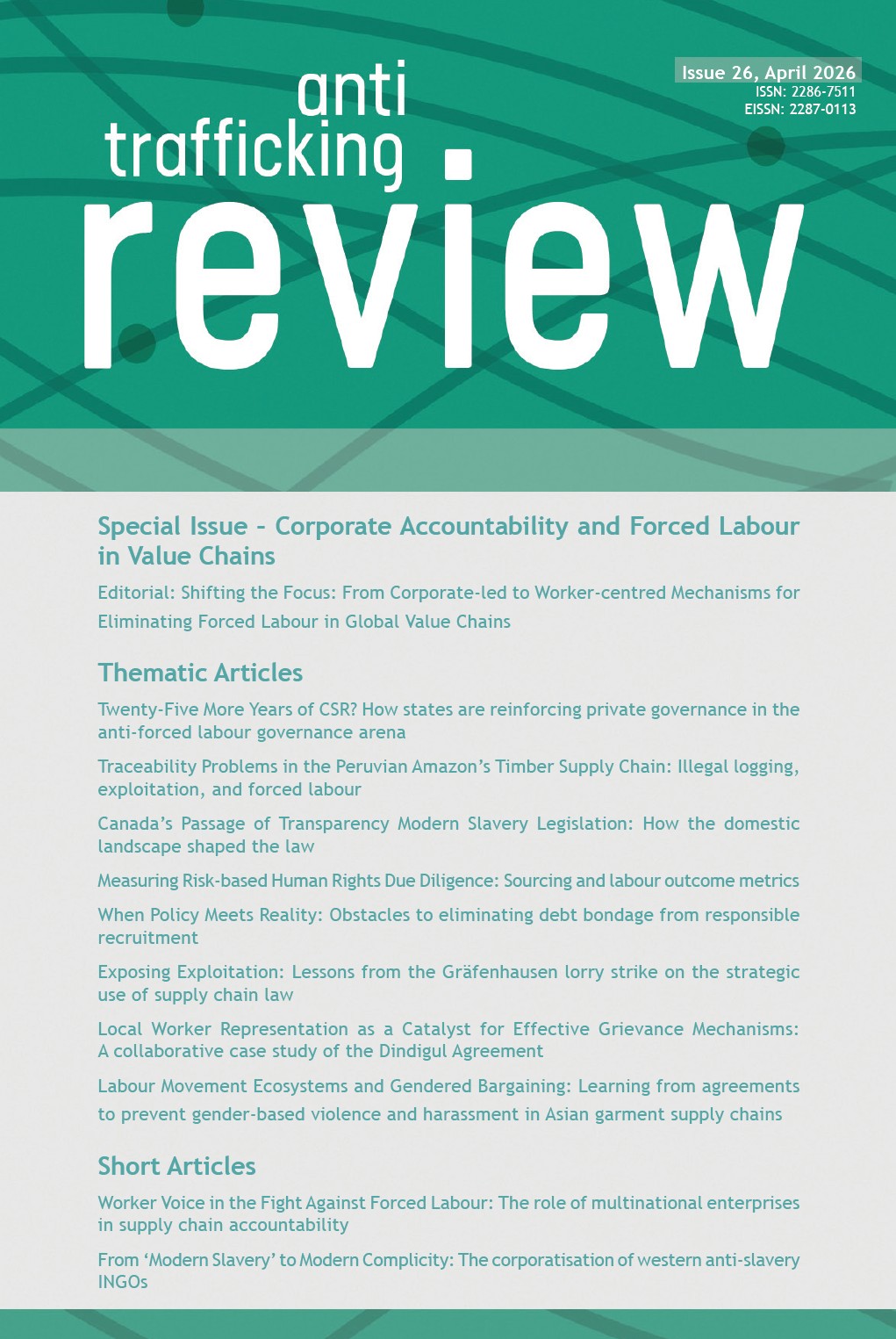
Labour Movement Ecosystems and Gendered Bargaining: Learning from agreements to prevent gender-based violence and harassment in Asian garment supply chains
DOI:
https://doi.org/10.14197/atr.201226269Keywords:
labour movement ecosystems, gender-based violence and harassment, Dindigul Agreement, Central Java Agreement, garment industry, global supply chains, freedom of association, collective bargaining, industrial relationsAbstract
This article highlights two global supply chain agreements to tackle gender-based violence and harassment in the garment industry—the Dindigul Agreement to Eliminate Gender-Based Violence and Harassment in India (2022), and the Central Java Agreement for Gender Justice in Indonesia (2025). The article is grounded in my experience negotiating and implementing both agreements. Drawing on and contributing to feminist theoretical advances in industrial relations, I argue that effective anti-GBVH supply chain agreements in the garment industry must be founded in freedom of association and embedded within labour movement ecosystems. I introduce the concept of labour movement ecosystem as a framework for analysing labour movement organisations and interrelationships, and the resulting impact and interactions within global supply chains, leading up to the signing and implementation of such agreements.
Metrics
Published
How to Cite
Issue
Section
License
Copyright (c) 2026 Anannya Bhattacharjee

This work is licensed under a Creative Commons Attribution 4.0 International License.
Under this license, the public is free to share, adapt, and make commercial use of the work. To protect our work and that of our authors, however, users must always give proper attribution to the author(s) and the Anti-Trafficking Review (i.e. with a complete bibliographic citation and link to the Anti-Trafficking Review website and/or DOI).