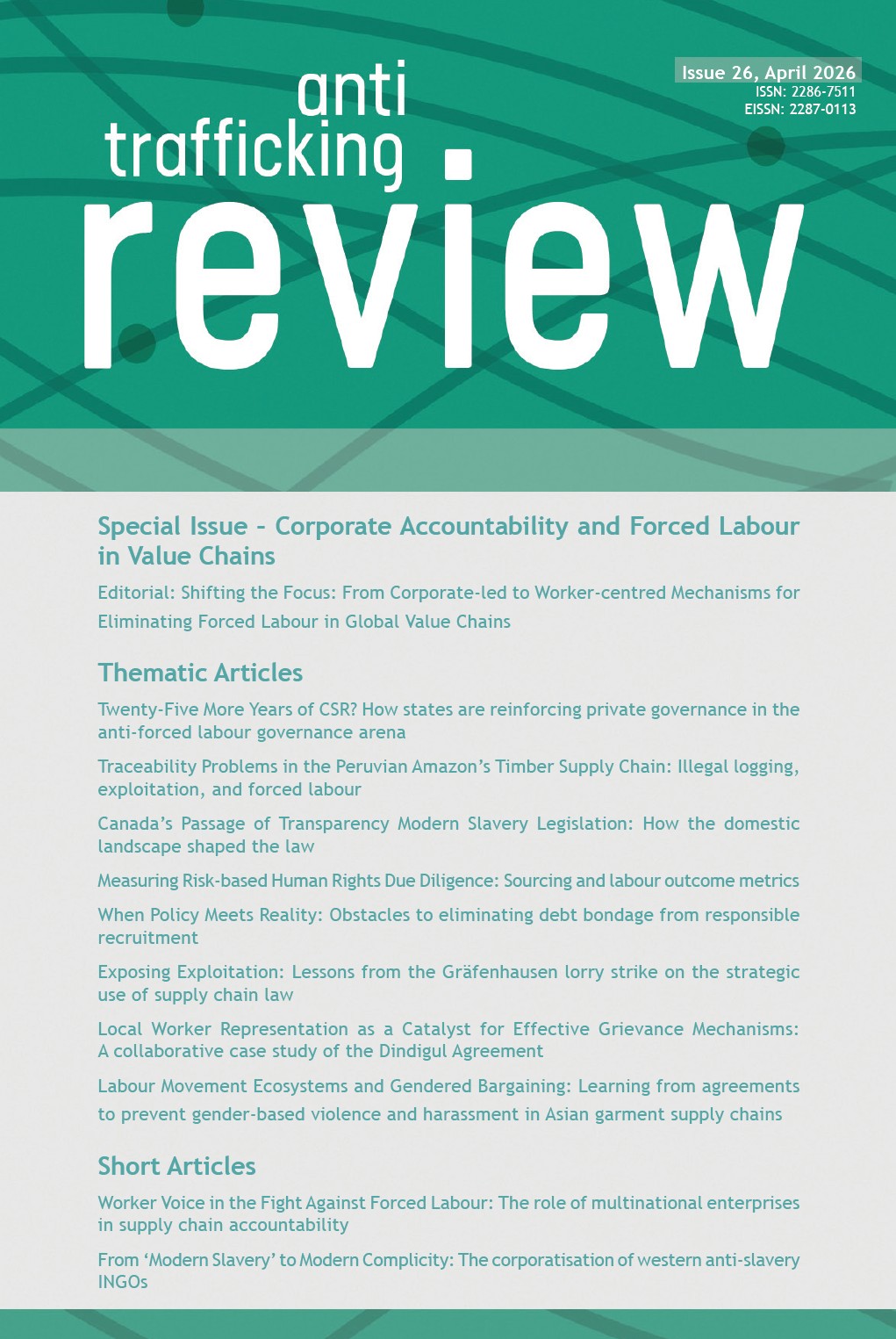
Twenty-Five More Years of CSR? How states are reinforcing private governance in the anti-forced labour governance arena
DOI:
https://doi.org/10.14197/atr.201226262Keywords:
transparency law, HRDD, ethical certification, corporate governance, ethical auditing, data analytics and AI, forced labour, due diligenceAbstract
Within anti-forced labour circles, there has been considerable excitement lately about governments taking on a more active role in tackling forced labour in supply chains. A common perspective is that after over 25 years of failed corporate social responsibility (CSR) efforts, governments have re-entered the arena; states’ enactment of responsive legislation (e.g. due diligence legislation or transparency legislation), import bans, and multi-lateral efforts, including through the G7, are often heralded as evidence of their stepping up. However, the extent to which this wave of government initiatives reinforces and relies upon, rather than replaces, CSR is frequently overlooked. In this article, I consider the ways in which recent government initiatives to tackle forced labour in supply chains expand the market, role, and governance power of unaccountable private actors, including auditing firms, data analytics and Artificial Intelligence companies, and certification bodies. I argue that unless governments enact far more ambitious regulation and restrictions on multinational enterprises, we are heading for another 25 years of deficient and inadequate private-led governance to address forced labour in supply chains.
Metrics
Published
How to Cite
Issue
Section
License
Copyright (c) 2026 Genevieve LeBaron

This work is licensed under a Creative Commons Attribution 4.0 International License.
Under this license, the public is free to share, adapt, and make commercial use of the work. To protect our work and that of our authors, however, users must always give proper attribution to the author(s) and the Anti-Trafficking Review (i.e. with a complete bibliographic citation and link to the Anti-Trafficking Review website and/or DOI).