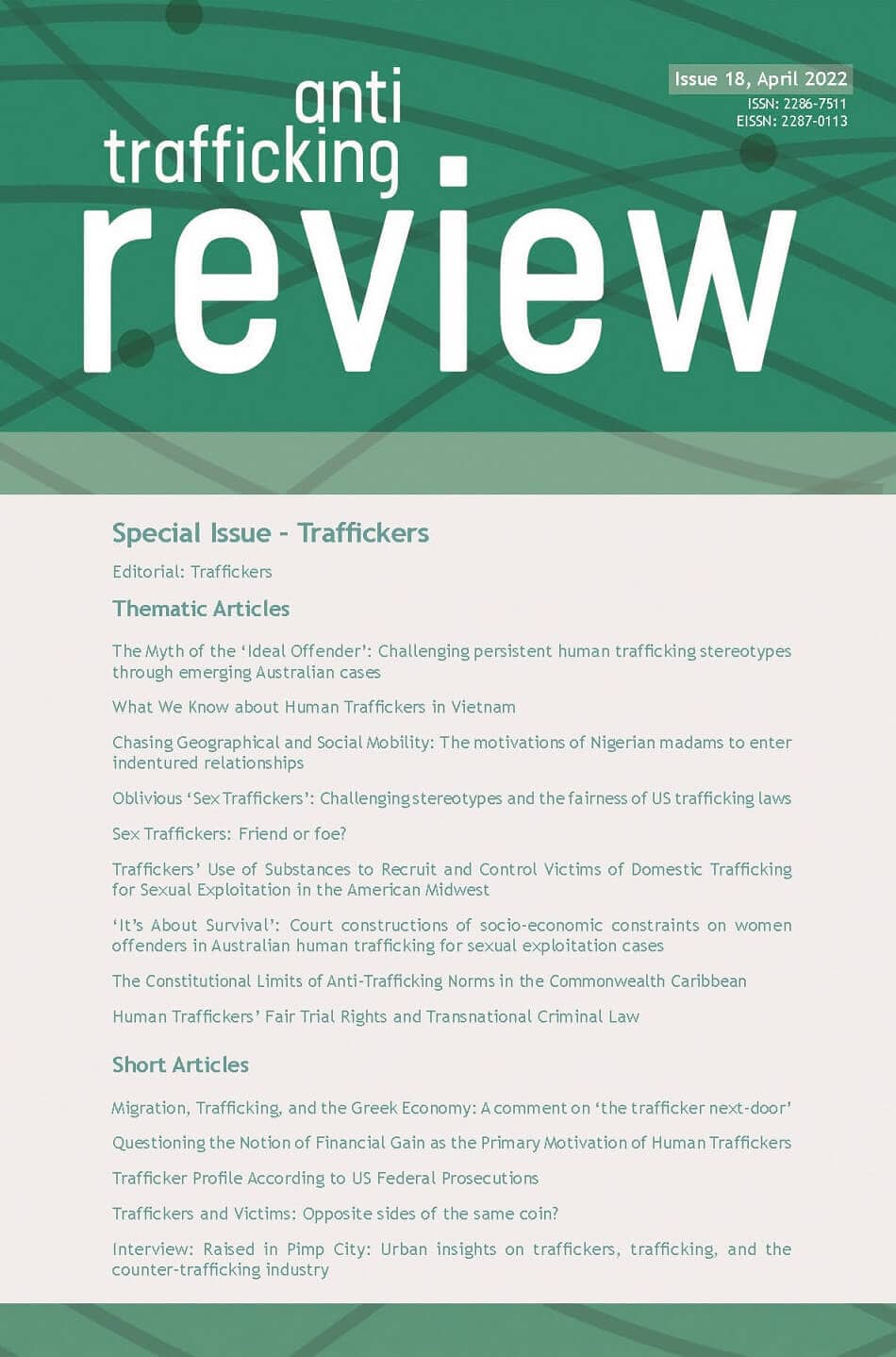
The Constitutional Limits of Anti-Trafficking Norms in the Commonwealth Caribbean
DOI:
https://doi.org/10.14197/atr.201222189Keywords:
traffickers, rule of law, separation of powers, constitutionality, fair trial, CaribbeanAbstract
Trafficking in persons is a crime and a human rights violation that affects most states across the globe, including those in the Commonwealth Caribbean. There- fore, in the last twenty years, governments have rushed to enact anti-trafficking laws with a level of alacrity the international community has never seen before. While the enactment of these laws is both necessary and desirable, some have pushed the limits of what is constitutionally permissible in a free and democrat- ic society. This article demonstrates that some of the prosecution provisions of anti-trafficking norms enacted by Caribbean governments have encroached or threaten to encroach upon the constitutional rights of accused persons. It concludes that unconstitutional provisions of regional anti-trafficking laws need to be addressed by regional governments as a matter of urgency, as they can potentially be challenged by traffickers with the result being that, if successfully challenged, traffickers may escape liability for crimes they have committed on mere technicalities.
Metrics
Published
How to Cite
Issue
Section
License
Copyright (c) 2022 Dr Jason Haynes

This work is licensed under a Creative Commons Attribution 4.0 International License.
Under this license, the public is free to share, adapt, and make commercial use of the work. To protect our work and that of our authors, however, users must always give proper attribution to the author(s) and the Anti-Trafficking Review (i.e. with a complete bibliographic citation and link to the Anti-Trafficking Review website and/or DOI).