
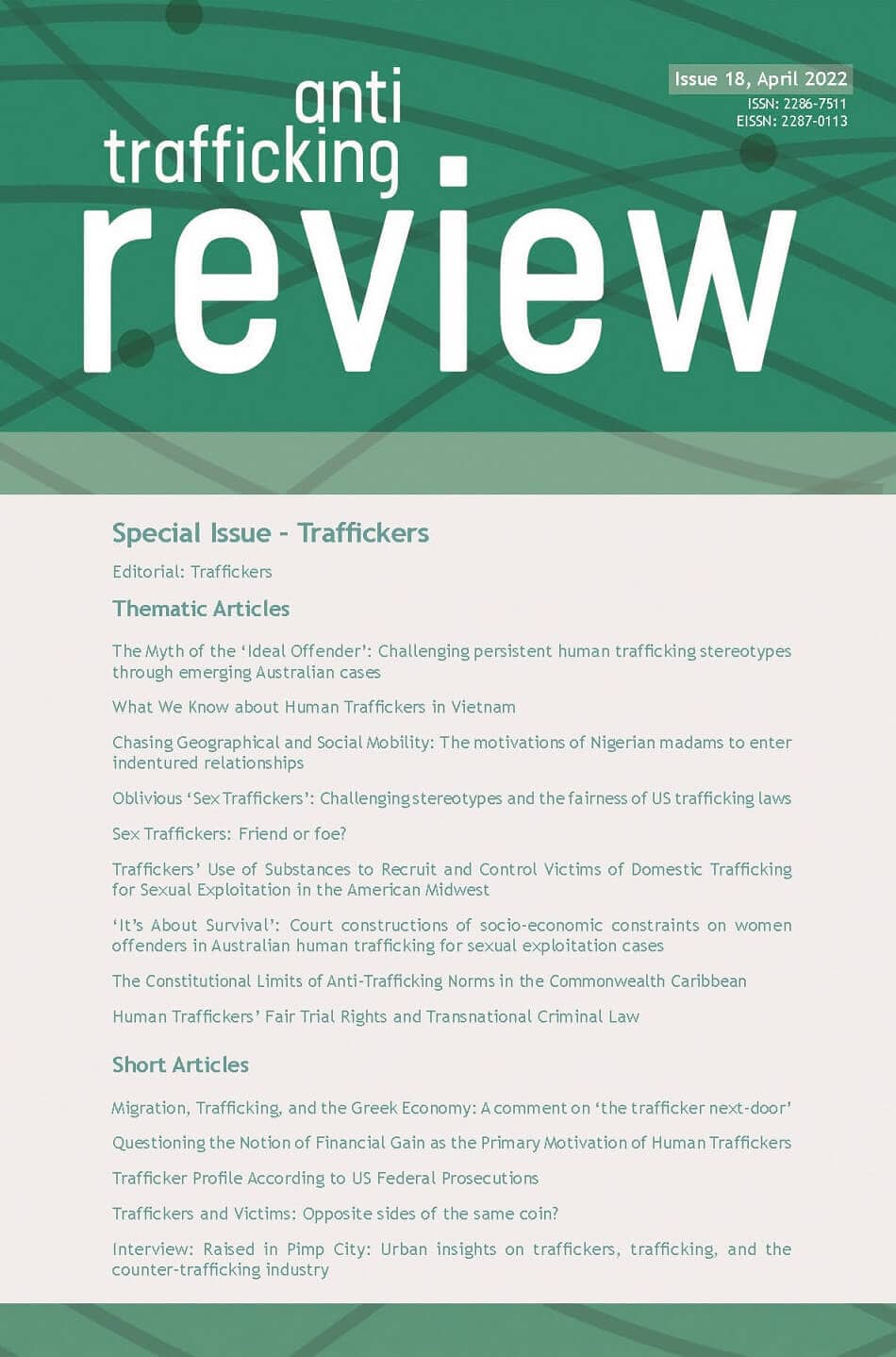
Chasing Geographical and Social Mobility: The motivations of Nigerian madams to enter indentured relationships
DOI:
https://doi.org/10.14197/atr.201222184Keywords:
trafficking, madams, traffickers, sex work, NigeriaAbstract
This article draws from interviews with Nigerian women convicted of trafficking for sexual exploitation in Italy to challenge the simplistic public narrative of traffickers as ruthless foreign men who coerce naïve women into migration and sex work. Madams’ narratives shed light on a reality of trafficking where both traffickers and victims share similar desires to overcome constraints imposed on their geographical and social mobility through their migration to Europe. Therefore, the article calls for the inclusion of traffickers’ perspectives into the knowledge on human trafficking, which is mainly victim-centred and justifies the current anti-trafficking approach aimed at victims’ protection and traffickers’ punishment. In the research context, taking into consideration the perspectives of all trafficking actors involved suggests the need to rethink Nigerian women’s indentured migration to Europe through sex work (and policies around it) in terms of attempts to achieve geographical and social mobility rather than transnational criminal activities. Finally, the article provides recommendations on how to address these issues both within the current anti-trafficking policy domain and beyond it, by calling for more open borders.
Metrics
Published
How to Cite
Issue
Section
License
Copyright (c) 2022 Milena Rizzotti

This work is licensed under a Creative Commons Attribution 4.0 International License.
Under this license, the public is free to share, adapt, and make commercial use of the work. To protect our work and that of our authors, however, users must always give proper attribution to the author(s) and the Anti-Trafficking Review (i.e. with a complete bibliographic citation and link to the Anti-Trafficking Review website and/or DOI).