Abstract
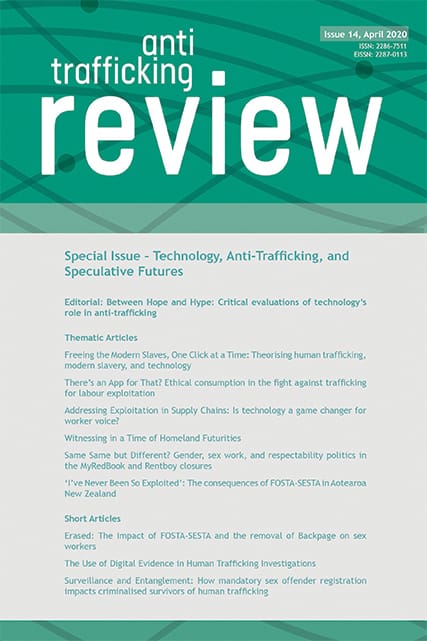
Over the past decade, scholars, activists, and policymakers have repeatedly called for an examination of the role of technology as a contributing force to human trafficking and exploitation. Attention has focused on a range of issues from adult services websites and the use of social media to recruit victims and facilitate trafficking to the utilisation of data analytics software to understand trafficking and identify ‘hotspots of risk’. This article introduces the Special Issue of Anti-Trafficking Review devoted to the role of technology in (anti-)trafficking. It outlines the main assumptions and critiques some of the proposed ‘solutions’ in the field and presents briefly the articles included in the issue. It concludes that the factors that enable and sustain human trafficking are varied and complex and require political will – not tech solutionist fixes.
Metrics
| PDF views | 2653 |
|---|
| HTML views | 1490 |
|---|
Author Biographies
-
Jennifer Musto
Jennifer Musto is an Associate Professor of Women’s and Gender Studies at Wellesley College. She is an interdisciplinary scholar whose research explores the laws, technologies, and modes of governance designed to respond to human trafficking and sex work in the United States. Her book, Control and Protect: Collaboration, carceral protection, and domestic sex trafficking in the United States (University of California Press, 2016) examines state, non-state, and technology responses to domestic sex trafficking situations in the US and she has lectured and published widely on these topics.
-
Mitali Thakor
Mitali Thakor is an Assistant Professor of Science in Society at Wesleyan University. She is an anthropologist of technology with interests in feminist and critical race studies of surveillance, policing, artificial intelligence, and robotics. Her book project, provisionally titled Facing the Child: The digital policing of child pornography, is an ethnographic study of the global network of experts tasked with the policing and content moderation of child abuse images.
-
Borislav Gerasimov
Borislav Gerasimov is Communications and Advocacy Coordinator at the Global Alliance Against Traffic in Women and the Editor of Anti-Trafficking Review. He holds a degree in English Philology from Sofia University St. Kliment Ohridski, Bulgaria and has previously worked at women’s rights and anti-trafficking organisations in Bulgaria and the Netherlands. He has also been involved in the work of organisations supporting Roma youth, LGBTI people, people living with HIV/AIDS, and sex workers.
License
Copyright (c) 2020 Jennifer Musto, Mitali Thakor, Borislav Gerasimov

This work is licensed under a Creative Commons Attribution 4.0 International License.
Under this license, the public is free to share, adapt, and make commercial use of the work. To protect our work and that of our authors, however, users must always give proper attribution to the author(s) and the Anti-Trafficking Review (i.e. with a complete bibliographic citation and link to the Anti-Trafficking Review website and/or DOI).
How to Cite
Musto, J., Thakor, M., & Gerasimov, B. (2020). Editorial: Between Hope and Hype: Critical evaluations of technology’s role in anti-trafficking.
Anti-Trafficking Review,
14, 1-14.
https://doi.org/10.14197/atr.201220141