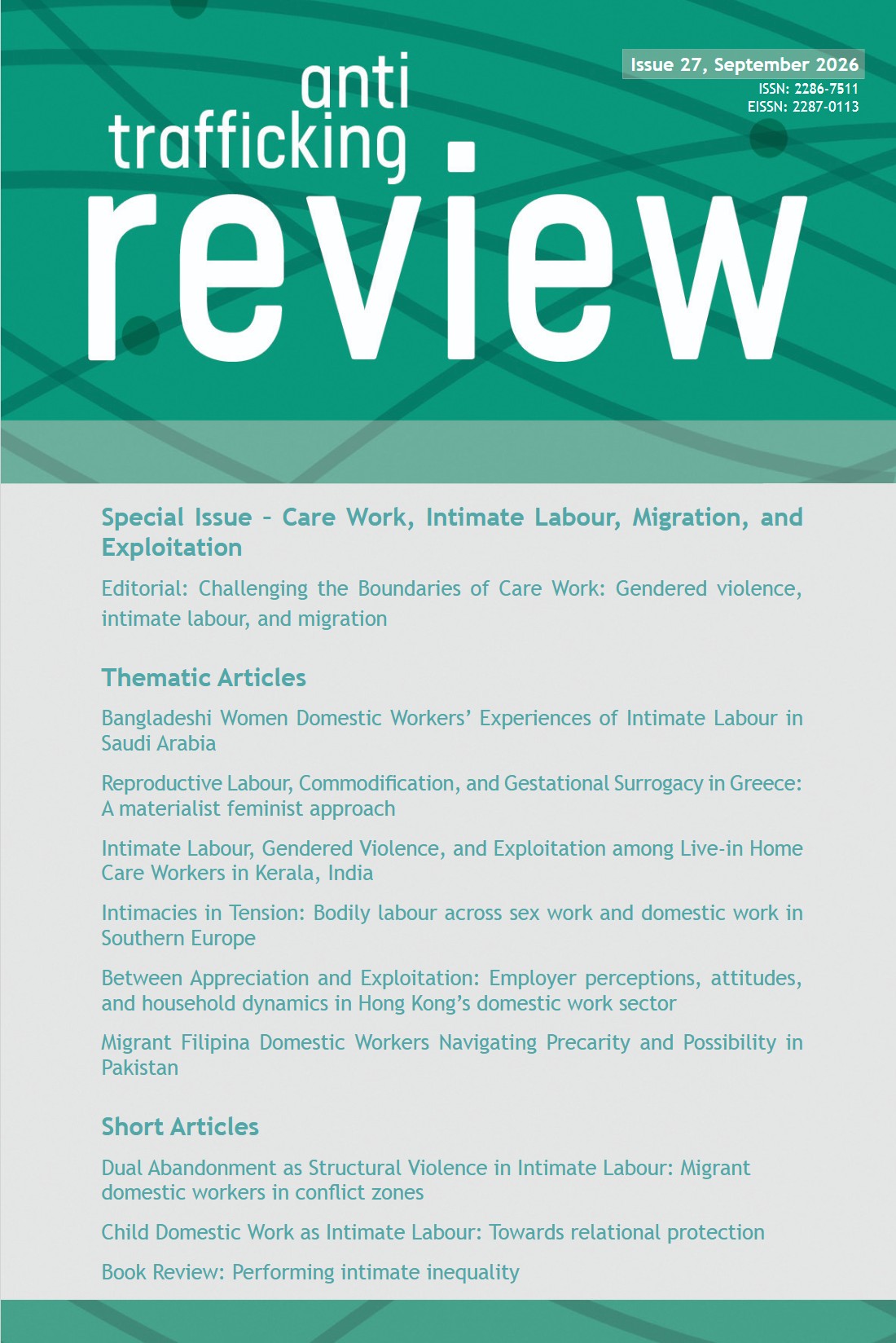
Between Appreciation and Exploitation: Employer perceptions, attitudes, and household dynamics in Hong Kong’s domestic work sector
DOI:
https://doi.org/10.14197/atr.201226276Keywords:
migrant domestic workers, employers, exploitation, attitudes, perceptions, Hong Kong, care workAbstract
Migrant domestic workers (MDWs) are essential to Hong Kong’s care economy yet remain structurally vulnerable to exploitation. While existing research has focused primarily on workers’ experiences, less attention has been paid to employers’ attitudes and practices and how they shape employment. Drawing on an intersectional framework, this article examines how gendered, racialised, and migrant inequalities shape employers’ attitudes towards MDWs and their engagement in exploitative practices. Based on 306 surveys and 15 semi-structured interviews with employers of MDW, we find that exploitative practices are associated with prejudicial, exclusionary, and controlling employer attitudes, revealing how racialised perceptions and restrictive migration regimes are translated into everyday practices of subordination. We demonstrate that exploitation frequently coexists with appreciation, gratitude, and dependence on caring labour, challenging assumptions that positive interpersonal relationships protect workers from exploitation. These findings contribute to debates on care work, intimate labour, and exploitation by showing how domestic work blurs boundaries between work and private life and how emotional intimacy and familial appreciation can coexist with structural inequality and control over workers’ autonomy. Exploitation is further shaped by gendered power relations, care responsibilities, economic pressures and household circumstances, highlighting how exploitation and care work are embedded within wider social and structural inequalities.
Metrics
Published
How to Cite
Issue
Section
License
Copyright (c) 2026 Isla Mairi Wilson, Yuniar Paramita Sari

This work is licensed under a Creative Commons Attribution 4.0 International License.
Under this license, the public is free to share, adapt, and make commercial use of the work. To protect our work and that of our authors, however, users must always give proper attribution to the author(s) and the Anti-Trafficking Review (i.e. with a complete bibliographic citation and link to the Anti-Trafficking Review website and/or DOI).