
Global Trafficking Prevalence Data Advances the Fight against Trafficking in Persons
DOI:
https://doi.org/10.14197/atr.201217811Abstract
We defend the proposition that global trafficking prevalence data—when gathered using validated methods and presented with sufficient detail on study design and data analysis—can advance the fight against trafficking in persons. Space does not allow us to engage in a full review and critique of existing data and methodologies, but we subscribe to the view that the field in general suffers from ‘“epidemiological anaemia”—lack of primary data collection based on sound sampling procedures’. We would add another condition: demographic disorder—unsystematic use and interpretation of population data. Until that situation improves, and it can best do so through systematic application of qualitative and quantitative ‘microlevel research’, we recommend that existing global prevalence data be presented with clearer caveats and used with due caution.
Metrics
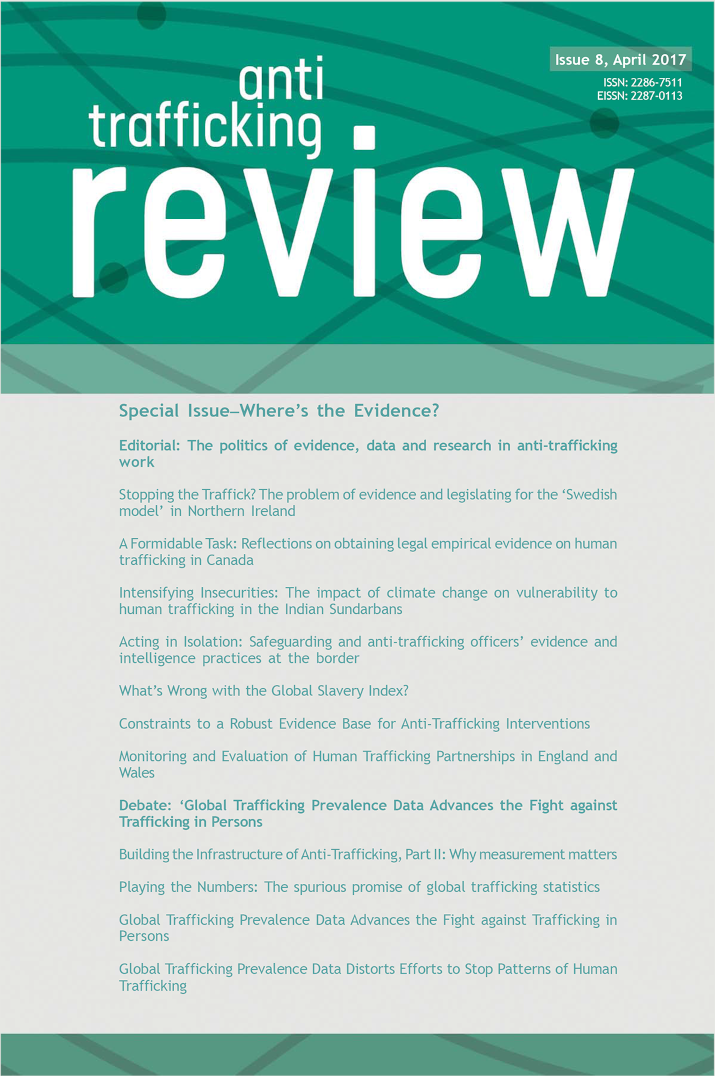
Published
How to Cite
Issue
Section
License
Copyright (c) 2017 Courtland Robinson, Casey Branchini, Charlie Thame

This work is licensed under a Creative Commons Attribution 4.0 International License.
Under this license, the public is free to share, adapt, and make commercial use of the work. To protect our work and that of our authors, however, users must always give proper attribution to the author(s) and the Anti-Trafficking Review (i.e. with a complete bibliographic citation and link to the Anti-Trafficking Review website and/or DOI).