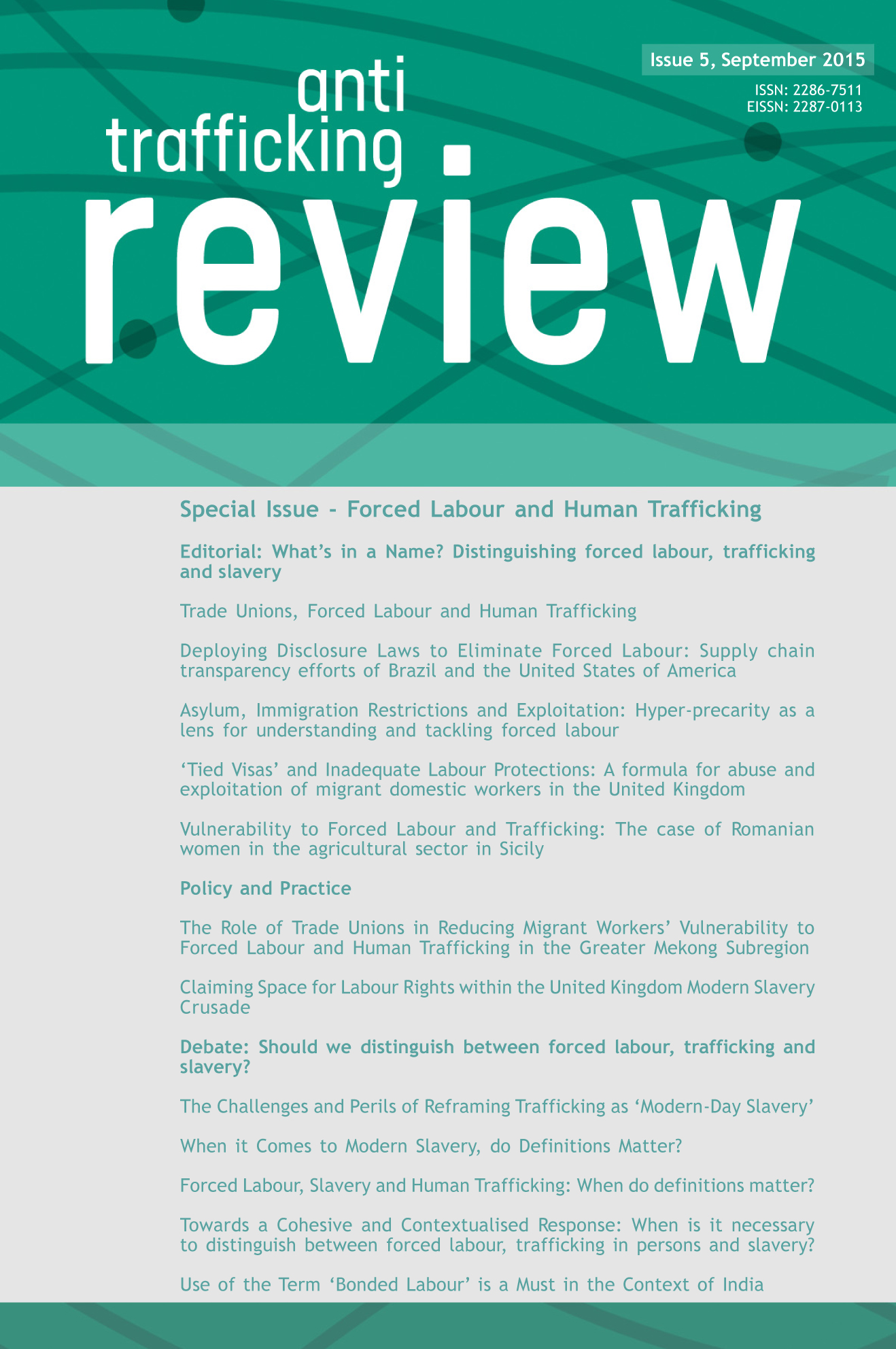
Authors
-
Nicola Piper
University of Sydney
-
Marie Segrave
Monash University
-
Rebecca Napier-Moore
Keywords:
anti-trafficking,
slavery,
human rights,
labour rights,
forced labour,
human trafficking
Abstract
Over the last fifteen years the parameters of anti-trafficking have shifted considerably. This shift has not been immediate or seismic. It has been a gradual shift, and what was once advocated for as a specific practice of trafficking is now associated with, and at times used interchangeably with, slavery and forced labour.
Metrics
| PDF views | 2075 |
|---|
| HTML views | 2495 |
|---|
Author Biographies
-
Nicola Piper, University of Sydney
Nicola Piper, a political sociologist, holds a PhD from Sheffield University, United Kingdom and is currently Professor of International Migration at the University of Sydney, Australia, School of Social and Political Sciences, and Affiliate Professorial Fellow at the Arnold Bergstraesser Institute, Freiburg University, Germany. She is external advisor on migration research to the UN Research Institute for Social Development, Geneva, and co-founder and Vice-President of the Global Migration Policy Associates initiative. Her research focuses on international migration for work, migrants’ labour and social rights, global and regional governance of migration as well as gender and migration. Her recent publications include the edited volumes New Perspectives on Gender and Migration: Livelihoods, rights, and entitlements (2008), South–South Migration: Implications for social policy and development (with Katja Hujo, 2010) and the co-authored book Critical Perspectives on Global Governance: Rights and regulation in governing regimes (with Jean Grugel, 2007). Email: nicola.piper@sydney.edu.au
-
Marie Segrave, Monash University
Marie Segrave is a Senior Lecturer in Criminology in the School of Social Sciences at Monash University. She is an Australia Research Council DECRA fellow in Irregular migrant labour exploitation 2014-2016, and her work is supported by this and by the ARC Discovery funding for The Australian Deportation Project (DP110102453). She has researched and published widely in the area of human trafficking and migrant labour and exploitation. Her publications include Sex Trafficking: International context and response (second edition forthcoming 2016) and Human Trafficking (ed. 2014). She leads the Trafficking and Labour Exploitation agenda on the Border Crossing Observatory (www.borderobservatory.org).
Email: marie.segrave@monash.edu
-
Rebecca Napier-Moore
Rebecca Napier-Moore is Editor of the Anti-Trafficking Review and has published on monitoring and evaluation in anti-trafficking, intersections between smuggling and trafficking, Feminist Participatory Action Research methodologies, women’s empowerment, and protracted refugee situations. She has been working in Asia for seven years, with a focus on programming and research to enhance the rights of women in migration. From 2008 to 2011 she served as the Research Programme Officer at the Global Alliance Against Traffic in Women. She has consulted for the Institute of Development Studies, UN Women, the Mekong Migration Network, the Center for Survivors of Torture, and the Asia Pacific Forum on Women, Law and Development. Email: atr@gaatw.org
License
Copyright (c) 2015 Nicola Piper, Marie Segrave, Rebecca Napier-Moore

This work is licensed under a Creative Commons Attribution 4.0 International License.
Under this license, the public is free to share, adapt, and make commercial use of the work. To protect our work and that of our authors, however, users must always give proper attribution to the author(s) and the Anti-Trafficking Review (i.e. with a complete bibliographic citation and link to the Anti-Trafficking Review website and/or DOI).
How to Cite
Piper, N., Segrave, M., & Napier-Moore, R. (2015). Editorial: What’s in a Name? Distinguishing forced labour, trafficking and slavery.
Anti-Trafficking Review,
5.
https://doi.org/10.14197/atr.20121551