
ISSN: 2286-7511
E-ISSN: 2287-0113
The Anti-Trafficking Review promotes a human rights-based approach to anti-trafficking. It explores trafficking in its broader context including gender analyses and intersections with labour and migrant rights.
ISSN: 2286-7511
E-ISSN: 2287-0113
The Anti-Trafficking Review promotes a human rights-based approach to anti-trafficking. It explores trafficking in its broader context including gender analyses and intersections with labour and migrant rights.
‘Employer Pays Principle’ (EPP) responsible recruitment policies of multinational enterprises (MNEs) aim to reduce risks of forced labour in supply chains by requiring all costs of labour recruitment to be borne by employers, not workers. Based on in-depth interviews with almost 4,000 foreign migrant workers in Japan, Malaysia, and Thailand conducted between 2020 and 2025, this paper investigates how effectively EPP policies were implemented across supply chains. Less than ten per cent of respondents experienced truly zero-fees recruitment. All others had to pay some or all of the costs of recruitment up front, with 14.6 per cent being indebted in the process, and only 12.2 per cent ever receiving reimbursement for some or all fees paid. When significant recruitment fees were discovered, most suppliers resisted reimbursing the full amount. Most MNEs were not willing to require the full amount be repaid to affected workers, nor share the reimbursement costs. The paper concludes by calling on MNEs to adopt more responsible contracting practices to make EPP recruitment possible by suppliers; share responsibility for reimbursing recruitment fees to impacted workers in their supply chains; and consider as not EPP-compliant suppliers employing workers who have paid recruitment fees, even if they reimburse them later.
Keywords: responsible recruitment, Employer Pays Principle, debt bondage, human rights due diligence (HRDD), supply chains
Suggested citation: A M Soto Bernal, L Rende Taylor, and M Taylor, ‘When Policy Meets Reality: Obstacles to eliminating debt bondage from responsible recruitment’, Anti-Trafficking Review, issue 26, 2026, pp. 97-115, https://doi.org/10.14197/atr.201226266
The contemporary global economy is fundamentally reliant on cross-border migrant labour, a process linked to the intricate architecture of global supply chains, which often relies on assembling a workforce at key sites.[1] While this mobility is a driver of economic growth, labour recruitment has become a primary site of vulnerability. Unchecked and deceptive recruitment practices can exacerbate poor working conditions and lead to extreme forms of exploitation, such as forced labour and debt bondage.[2] To address the endemic risks in the migrant labour system and ensure that globalisation does not facilitate these human rights abuses, international focus has shifted towards effective worker protection mechanisms. As one powerful countermeasure, institutions are increasingly examining how robust collective agreements can be leveraged to extend and enforce fundamental labour protection standards, mitigating the systemic failings embedded in global recruitment corridors.[3]
This paper explores the dynamics of such labour recruitment in a globalising world, analysing the gap between corporate social responsibility commitments of multinational enterprises (MNEs) and the operational realities in their supply chains. Based on an empirical assessment of MNE policies at scale across multiple supply chains and countries, it was found that: less than ten per cent of respondents did not pay any recruitment fees, suppliers resisted reimbursing to workers the full amount of fees they paid, and MNEs were not willing either to require that workers not pay recruitment fees or share responsibility of reimbursing recruitment fees paid by workers. The paper concludes by recommending that MNEs adopt more responsible contracting practices to make EPP recruitment possible by suppliers by sharing responsibility for reimbursing recruitment fees paid by workers in their supply chains and having clear EPP compliance standards and practices.
Responsible/ethical recruitment has received increasing attention in social responsibility spaces in recent years as companies seek higher confidence that risks of human trafficking, forced labour, debt bondage, and exploitative recruitment are eliminated from their supply chains. Responsible recruitment is especially important for brands and retailers importing into countries with laws prohibiting the import of goods made with forced labour—such as the Tariff Act in the United States—as worker-paid recruitment fee linkages to debt bondage and other exploitation can lead to customs law enforcement action. Indeed, between 2020 and 2023, US Customs and Border Patrol’s (CBP) forced labour enforcement efforts under the Tariff Act have resulted in the repayment of over USD 50 million in worker-borne recruitment fees and withheld wages that trapped workers in debt bondage.[4]
Responsible recruitment, a rising priority in corporate social responsibility spaces, is intended to reduce risks of forced labour and debt bondage. It could also be used by companies to strengthen their human rights due diligence (HRDD) policies and procedures, which are increasingly mandatory. Human rights due diligence requires functioning, credible grievance mechanisms and ongoing engagement with workers and communities to ensure that workers/rightsholders shape the view of a company’s human rights footprint over time.[5]
Corporate responsible recruitment policies often centre around the ‘Employer Pays Principle’ (EPP), which requires all fees and related costs of recruitment of workers in their supply chains to be borne by employers, not jobseekers and workers.[6] These costs include all costs incurred during the recruitment process, including fees charged by an employer and/or subsidiaries, labour recruiters and employment agencies, and other third parties providing related services. Any illegitimate or undisclosed costs to brokers, sub-brokers, or other actors are also prohibited.[7] This definition is in line with the Dhaka Principles endorsed by the Leadership Group for Responsible Recruitment, the Code of Conduct for the World Employment Confederation, and ILO Convention No. 181 on Private Recruitment Agencies.[8]
MNEs committed to EPP are still a minority but are growing in number, at least in some sectors. Assessments by KnowTheChain (a resource and benchmarking initiative for investors and companies to identify and address forced labour risks in global supply chains) of the disclosures and policies of 45 information, communications, and technology (ICT) companies and 60 food and beverage companies showed a marked difference in approaches to responsible recruitment. Among the ICT companies assessed in 2025, 96 per cent disclosed a policy prohibiting recruitment fees in their supply chains. However, while many policies emphasise fee prevention and reimbursement for employees, they often lack a formal requirement for employers to directly assume the financial burden of recruitment. Additionally, only 13 per cent of companies disclosed the due diligence steps to make sure workers are not charged fees in the first place.[9] Conversely, in 2023, from the 60 major food and beverage companies assessed, only half disclosed a policy prohibiting recruitment fees in their supply chains, and only 28 per cent of companies’ policies aligned with EPP.[10]
The Institute for Human Rights and Business (IHRB) launched a Leadership Group for Responsible Recruitment in May 2016, with a membership of 17 MNEs committing to EPP policies and whose mission was ‘the total eradication of recruitment fees being charged to workers anywhere by 2026’.[11] As of January 2026, 406 companies have been identified with publicly available policies that ‘have partly or fully assimilated the Employer Pays Principle.’[12] However, while EPP is international best practice, its successful implementation is consistently thwarted by the global value chain structure, which incentivises low-cost production and creates an environment where recruitment costs are systematically externalised onto the most vulnerable workers.
Despite growing international consensus around EPP and many global brands and retailers employing zero recruitment fee policies in their supplier codes of conduct, national laws in production countries do not necessarily align with these standards. A 2020 International Labour Organization (ILO) study on recruitment fees and related costs examined policies across 90 countries. The study identified 63 policies explicitly prohibiting the charging of recruitment fees and costs to workers, with 62 per cent (39 of 63) coming from countries in Europe and the Americas, and less than 5 per cent (3 of 63) coming from Asia-Pacific countries.[13] For Asian suppliers within American and European supply chains, these inconsistencies between national laws and global customer standards can be a source of tension, creating three distinct categories of fees that could exist in their supply chains:
Illegal fees. Workers are charged fees that are both in violation of national laws (i.e., illegal) and non-compliant with EPP requirements;
Legal but non-EPP compliant fees. Workers are charged fees that are legal under national laws, but not in compliance with corporate EPP policy requirements; and
EPP. Workers who paid no fees for their job, thus in compliance with both national laws and corporate EPP requirements.
It should not be surprising, then, that much cross-border labour recruitment across the globe falls far short of responsible recruitment standards. In Southeast Asia, for example, Issara Institute’s[14] experience of working with workers and businesses across a wide range of export-oriented industries over the past decade has shown that the general practice of employers and recruitment agencies has been, directly or indirectly, to push many (and sometimes all) recruitment-related fees and costs onto workers, who are willing to pay for desperately needed jobs, and sometimes fall into debt bondage in the process.
A further challenge is confusion around what exactly is required to meet corporate responsible recruitment and more specifically EPP policies, beyond that which is stipulated in national law. This confusion is caused by often vaguely worded buyer policies and insufficient communication from buyers on how to delineate costs that are above and beyond legal requirements. With a growing number of global brands and retailers adopting responsible recruitment policies, including EPP, it is important to assess what is working and what is not.
The objective of this mixed-methods research study is to leverage Issara Institute’s position on the ground, running independent worker voice channels within MNE supply chains, oftentimes in partnership with MNEs, to better understand the real outcomes and consequences of EPP policies on workers, suppliers, and recruitment agencies. Recommendations will then be proposed on how to better bring responsible recruitment policies into practice and ensure corporate accountability for recruitment-related forced labour and exploitation in value chains.
Our research objective was to investigate: (a) exactly what brands and retailers required of suppliers to consider them in compliance with their ethical recruitment policies, and (b) what changed in response to business policies and practice as well as impacts on workers. Our mixed-method approach included the collection and analysis of qualitative and quantitative data around business policies related to responsible recruitment, business practices related to labour recruitment, and worker experiences and outcomes related to their recruitment, via:
Randomised representative sample surveys interviewing workers from Myanmar, Cambodia, Thailand, Nepal, Indonesia, Vietnam, China, Mongolia, and the Philippines in Thailand, Malaysia, and Japan about recruitment fees and experiences (n=3,788). These interviews were from 35 first-tier supply chain companies.
In-depth interviews with suppliers, recruitment agencies, and global brand and retailer MNEs (n=42).
The recruitment fees within the scope of the interviews consist of all recruitment related costs including fees charged by recruitment agencies as well as by brokers and sub-brokers. This definition is in line with the Employer Pays Principle of the Leadership Group of Responsible Recruitment, the Code of Conduct of the World Employment Confederation, and ILO Convention No. 181.
Individual worker interviews were carried out between January 2020 and January 2025 as part of larger, often workplace-wide recruitment fee surveys organised in collaboration with the management of those sites as well as at least one of their global brand/retailer customers (Issara Strategic Partners). The interviews with workers were conducted in private, without any intervention from the suppliers or buyer representatives. Issara Institute implemented mixed-methods surveys with robust randomised representative samples of workers drawn from rosters provided by the suppliers for each workplace.[15] The sample of workers included in this study, an aggregation of all the interviews from these workplace surveys, are described in Table 1. The analysis conducted took the following variables into account: workers’ nationality, workers’ destination countries, and companies’ EPP policies, including the dates such policies entered into force, to compare recruitment fees paid by workers before and after policy.
|
Destination country and industries |
Nationality of workers |
Number of workers |
|---|---|---|
|
Japan (n=102): Food and beverage, health and beauty, household goods, packaging, plastics, recycling, services |
Burmese Chinese Filipinx Mongolian Thai Vietnamese |
4 2 45 2 6 43 |
|
Malaysia (n=133): Packaging, rubber products |
Burmese Indonesian Nepali Pakistani |
3 5 112 13 |
|
Thailand (n=3,553): Apparel, electronics, food and beverage, packaging, poultry, seafood |
Cambodian Burmese Lao |
369 3,179 5 |
In addition to in-depth interviews with the suppliers and recruitment agencies associated with the workforce surveys noted above (n=42), we conducted three rounds of interviews with 12 Thai suppliers in the seafood, garment, and poultry industries to collect initial insights regarding the state of EPP from policy to practice in Southeast Asia. This was followed by a second more in-depth interview and focus group discussions with select suppliers to discuss the study’s emerging findings. In addition, 10 Myanmar recruitment agencies that send workers to Thailand, Malaysia, Japan, Singapore, and Qatar participated in two rounds of individual interviews, and the preliminary findings from these discussions were further ideated with five MNEs. The interviews and focus group discussions were carried out between January 2022 and March 2025, and all participating businesses had a pre-existing relationship with Issara Institute as well as either prior experience with employer pays policies or a commitment to implementing them for future labour demands.
The methods employed in this research were diverse, each attempting to capture a view of the perspectives of different key stakeholders and workers in the international labour recruitment process, and the underlying relationship and power dynamics between them. Specifically, in-depth interviews with suppliers and recruitment agencies clarified their respective systems and intentions but would not be able to verify the real experiences of workers. For this reason, the data collected from the surveys with workers is fundamental to triangulate the data from the findings. Conversely, worker reports of recruitment experiences and fees were vital for validating the ultimate outcomes of these business relationships but alone would be insufficient for understanding the nature of those business relationships. We found this mix to be critical since, taken alone, the insights of just workers or just one facet of business would yield an incomplete picture of forced labour within labour recruitment, and corporate responses and accountability.
The sample of worker-reported data is heavily weighted towards Burmese migrant workers in Thailand (approximately 84% of the total sample of 3,788), reflecting regional migration patterns and the export-oriented value chains relevant to Issara Institute’s work. The corridor-specific data regarding fees should not be generalised to represent average fees within these corridors, or within other corridors. Since the sample is skewed towards MNEs and suppliers already willing to engage on ethical recruitment issues, the amounts of recruitment fees and debt bondage in this sample may not be representative of the experiences of all migrant workers in and from these countries. The business responses to these human rights issues are also not expected to be typical for all suppliers hiring foreign workers in these countries, nor for all MNEs sourcing from these countries.
For these reasons, the quantitative results are presented in two ways: (a) the aggregated all-corridor data for a macro view, and (b) a disaggregated analysis focusing specifically on the Myanmar-Thailand corridor, as this sub-sample allows for the most robust statistical inferences.
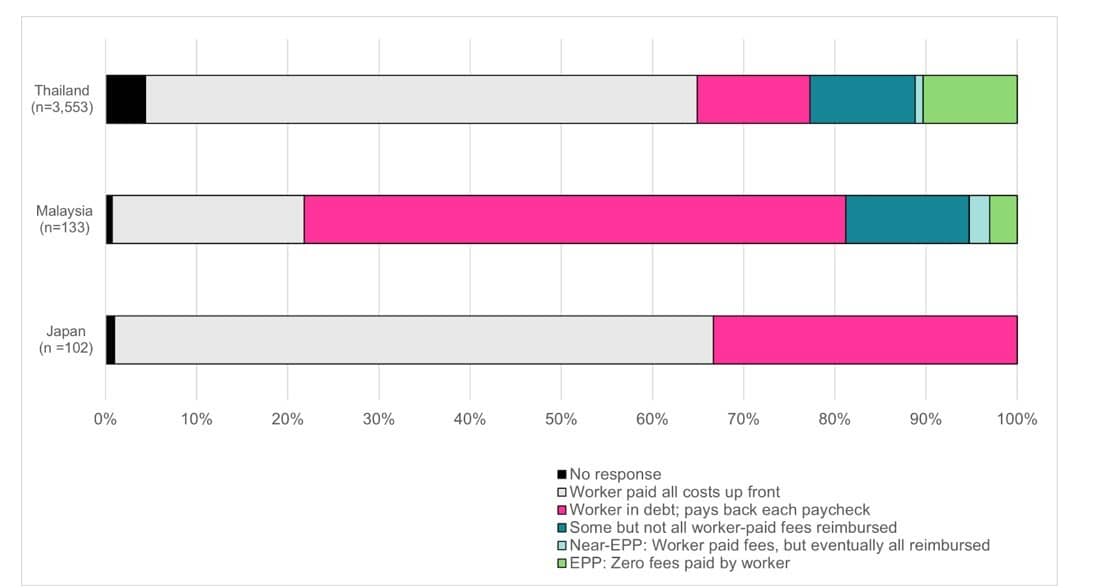
Only 9.80 per cent (371/3,788) of worker respondents experienced truly zero-fee recruitment, as illustrated in Figure 1. All others had to pay some or all of the costs of recruitment up front, with 14.6 per cent (553/3,788) becoming indebted in the process, and only 12.2 per cent (461/3,788) ever receiving reimbursement by their employer (the supplier) by the time of the survey for some or all recruitment-related fees. The means and ranges of worker-paid recruitment fees as reported by workers, and mean amounts of reimbursements by employers (suppliers), is summarised in Table 2.
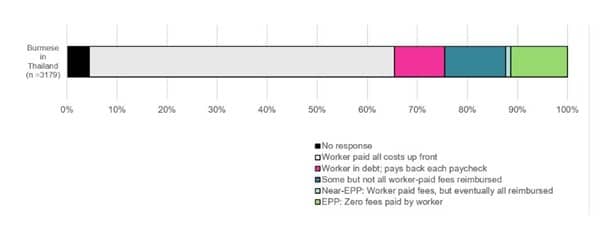
Burmese workers in Thailand represented the bigger sample size of this research given that they represent the majority of migrant workers in Thailand followed by Cambodian workers. Given the difference with the rest of nationalities covered in this research, the data of Burmese workers in Thailand was analysed separately. As shown on Figure 2, 11.4 per cent (361/3179) of respondents reported zero-fee recruitment and all other Burmese workers in Thailand had to pay some or all of the recruitment cost.
|
Destination country |
Mean and range of fees paid by workers before recruitment (USD)* |
Monthly minimum wage as reference (USD)* |
Mean reimbursement paid by employer (the supplier) by the time of the survey (USD)* |
|---|---|---|---|
|
Japan Malaysia Thailand |
$3,641.49 [$0–$8,900] $862.50 [$0–$4,348] $319.24 [$0–$3,009] |
$1,050 $400 $300–$350 |
$0 $273.03 $17.60 |
|
* Referencing currency exchange rates on 15 June 2025. |
|||
The EPP policies of the MNEs within the scope of this research had different implementation dates. Table 3 illustrates how the EPP policies of MNEs coming into force impacted the mean recruitment fees paid by workers, starting from the first mile (village-level broker fees) up to arriving at the workplace, including fees for training required by the employer.
The implementation of the EPP policies and the effect on reduction or elimination of recruitment fees for workers varied significantly based on the recruitment corridors. For instance, in the Myanmar-Thailand corridor, there was no significant change pre- and post-EPP policy.
However, in the Cambodia-Thailand corridor, the recruitment fees increased 20.1 per cent post-EPP policies. This was a result of the weak service agreements between the recruitment agencies and the suppliers; both parties had no clarity of EPP policies and fees to be covered by the supplier. This lack of clarity resulted in recruitment agencies charging excessive recruitment fees to Cambodian workers. The date of enforcement of EPP policies varied within the sample; however, the data was analysed based on the relevant EPP enforcement date per interviewee, which determined the pre- and post-EPP fees described in Table 3.
|
Recruitment corridor |
Mean of fees paid by workers before EPP policies (USD) |
Mean of fees paid by workers after EPP policies (USD) |
% change |
|---|---|---|---|
|
Philippines-Japan Vietnam-Japan Myanmar-Thailand Cambodia-Thailand Nepal-Malaysia Pakistan-Malaysia |
$366 $7,440 $268 $603 $1,014 N/A |
$230 $5,540 $266 $727 $855 $362 |
37.15% reduction 25.5% reduction 0.7% reduction 20.1% increase 15.6% reduction N/A |
Workers paying all costs up front had to make financial decisions directly impacting their and their families’ livelihoods, such as selling properties, pawning goods, or taking loans. In addition to the unethical recruitment practices at the first mile, the political situation in Myanmar, the unpredictable changes in the recruitment regulations, and forced conscription laws, as well as violence, have had a significant impact on the recruitment experiences of Myanmar job seekers. These factors have driven job seekers to migrate through irregular channels to Thailand, with recruitment processes being facilitated by informal brokers in Myanmar and Thailand at high cost.
[I am] from Mandalay. I was informed by [broker in Myanmar] about a job at a garment factory. [I] and three other workers from our village were asked to pay THB 30,000 (USD 918) to get a job at [garment factory name]. [We] sent MMK 1,000,000 (USD 236) each to [broker in Myanmar]. [I am] still paying debt and owe about THB 10,000 (USD 306)[16] to [broker in Myanmar] until now. [Broker in Myanmar] has a connection with a worker from the garment factory who informed [about] job vacancies. [I] don’t know if that worker gets money from [informal broker in Myanmar]. [I] had to wait about four months in Thailand, and just started working at the [garment factory] a month ago.[17]
Additionally, workers recruited through regular channels (the Government-to-Government Memorandum of Understanding) were led to believe by their employer they would be reimbursed for the recruitment-related fees they paid, but then received no reimbursement, facing deception and debt in EPP recruitment process.
In the case of Malaysia, there was a decrease of 15.6 per cent in the recruitment fees paid by Nepali workers post-EPP policies. However, the mean of the fees paid by workers but not reimbursed by employers was still high—USD 589.47—about 1.5 times the monthly minimum wage (see Table 2). Similar to workers going to Thailand, many workers going to Malaysia reported having to take loans from moneylenders at exorbitant interest rates.
I took a loan from one of the local loan sharks to pay off the cash amount asked by the agent. I took a loan on 35 per cent interest and it took me nine months to pay off that loan. The interest was charged on a monthly basis, and my loan amount was NPR 200,000 (USD 1,454). So every month I pay NPR 4,500 (USD 32)[18] as interest.[19]
In addition to taking loans to pay recruitment-related fees, workers also reported how recruitment agencies ask them to sign affidavits saying they did not pay any recruitment fees, or paid only legal fees, before migrating abroad.
[I] was aware of the ‘free visa and free ticket’ policy implemented by the Government of Nepal. They even had us sign a document acknowledging this policy. However, it was disheartening to discover that they [the recruitment agency staff] still charged us NPR 100,000 (USD 727) for processing fees. Additionally, the medical expenses amounted to NPR 9,000 (USD 65), and there was a NPR 1,000 (USD 7) fee for orientation, although we didn't actually participate in a stay-in orientation class. Furthermore, I incurred travel expenses of NPR 6,000 (USD 44) for two trips to Kathmandu.[20]
For Vietnamese workers in the sample, there was a reduction of 25.54 per cent in fees paid after EPP policies. However, the fees paid by Vietnamese workers were the highest across all nationalities of workers in Japan in the sample, paying up to nearly USD 8,900, equivalent to nearly 8.5 months of wages at Japan’s minimum wage rate. All the fees charged to foreign workers in Japan were charged in the origin countries, and in most cases, charged by the recruitment agencies directly. Recruitment fees cannot be charged by Japanese employers to workers in Japan; however, Japanese employers within the scope of the research had mixed practices of EPP implementation, where some suppliers paid all recruitment-related fees to the recruitment agencies, others made partial payment, and others did not provide information if they paid or not the recruitment fees to the recruitment agency. Moreover, unethical practices by the recruitment agencies in origin countries were reported by workers, especially in the case of Vietnamese workers who were charged excessive fees without being provided any information about the fee details, or any proof of payment.
The total fees I paid was USD 7,700. The recruitment company was shady; they were being vague about it. They didn’t give me any receipt either, they just quoted the price and asked me to pay. The cost for each expense is not listed.[21]
In addition to the recruitment-related fees, the surveys with workers also provided insights on the recruitment process risks starting from the ‘first mile’ and up to arrival at the workplace. For instance, workers migrating to Thailand and Malaysia reported paying high fees to informal brokers at the village level, due primarily to a lack of or limited information about job opportunities and related fees, and brokers making false promises about the opportunities and benefits of the position. There were also several cases where workers were asked by recruitment agencies to pay the fees in advance and be reimbursed later by the recruiter or employer, after signing contracts in the country of destination, or after passing a three-month probation period. However, the percentage of the fees reimbursed was low or no reimbursement was made at all, as illustrated in Figure 1 and Table 2.
When illegal and/or unallowed worker-paid recruitment fees were discovered by our workplace surveys, most suppliers resisted reimbursing the full amount to workers. Faced with this pushback, most MNEs negotiated with their supplier and did not require the full amount be repaid to affected workers. Further, MNEs were unwilling to share the reimbursement costs, as might be expected according to the principle of shared responsibility.[22] In the end, the suppliers in the survey in Japan refused to pay back any of the worker-paid fees reported by workers; suppliers in Malaysia had made partial reimbursements before the surveys with workers and did not make any additional reimbursement after the survey findings; and the suppliers in Thailand were required by their customers, the MNEs, to reimburse the workers, though only 6 of the 34 (17.6 per cent) suppliers included in this sample made reimbursements of the full amount owed to workers.
The findings also included key points regarding points of risk in the recruitment process and recommendations for risk reduction and systems strengthening, for example, identifying high-risk recruitment agencies using informal brokers, human resources staff operating in corrupt or unethical ways, and systems capacity gaps. For these non-financial recommendations, most suppliers agreed to implement at least some if not all of the recommendations to strengthen systems and mitigate risk.
Our research provides evidence of a profound and persistent gap between the ethical recruitment policies adopted by MNEs and their effective implementation on the ground. Despite the adoption of the Employer Pays Principle (EPP) as the de facto standard for responsible recruitment, a mere 9.8 per cent of the 3,788 migrant worker respondents across all surveyed corridors reported a genuinely zero-fees experience. Additionally, MNEs accepted suppliers reimbursing recruitment fees to workers months after workers started working, instead of ensuring that the costs of recruitment (visas, work permits, medical checks, travel, and other associated expenses) are paid directly by businesses at the time that payment is required.
To take responsible recruitment from policy to practice across global supply chains, MNEs need to source from suppliers (who are the direct employers) that pay all the costs of their workers’ recruitment in advance of the workers’ arrival, which is a cost over and above the amounts required to be paid by employers as per national law. In addition, suppliers must also effectively build and invest in functioning responsible recruitment business systems. There should be buy-in by leadership, management, and HR. Preparation steps may include: new recruitment policies; overhaul of existing recruitment practices, including employment contracts with workers and service contracts with recruitment agencies; improved due diligence and vetting of recruitment agencies; strengthened worker feedback channels and grievance mechanisms; human resource staff expansion, upskilling, or upgrading; and partnerships with external organisations such as non-profits that can empower workers, reduce risks, and improve transparency.
These steps entail considerable cost and effort on the part of suppliers, but can significantly strengthen internal business systems, reduce recruitment risks, align with buyer policy requirements, and improve worker retention and productivity. The overall cost of recruiting new workers would naturally increase, and potentially significant remediation fees may also need to be repaid to workers, if formal or informal fees were found to have been paid during their recruitment journeys.
For suppliers, then, when do the benefits of investing in EPP-compliant responsible recruitment systems outweigh these significant costs? Examining the perspectives of businesses—suppliers, recruitment agencies, and buyers—helps explain corporate action (and inaction) in making responsible recruitment across supply chains a reality.
There is limited global buyer adoption of EPP policies and a lack of incentives for suppliers and therefore for recruiters to fully invest in responsible recruitment—just penalties for non-compliance and unsustainable business. Many supplier respondents reported that they only had a limited number of (or no) buyers with policies prohibiting suppliers and recruiters charging workers recruitment-related fees, and an even smaller number of buyers that explicitly required compliance with EPP. Several suppliers, however, did express they believed the demand for responsible recruitment would only grow over time[23]—highlighting the importance of timing and the need for a critical mass of buyers (or at least involvement of strategic customers) to require responsible recruitment before suppliers adopt higher standards. Despite the hope for growth in the adoption of EPP policies, the current limited demand is also having a high impact on recruitment agencies and their ability to sustain their business by accepting only contracts that require full EPP-compliance. Many recruitment agencies in our research informed us that they were keen to become fully EPP-compliant, but it was impossible due to insufficient demand for responsible recruitment by suppliers. One Myanmar recruitment agency attempting to transition exclusively to responsible recruitment stated in July 2022 that all their customers followed Employer Pays Principle policies. However, by April 2023, it was struggling, down to only one customer willing to cover all recruitment fees. The agency was unable to find more suppliers committed to zero-fees recruitment for workers, and as of 2025 it was challenging to stay in business and uphold its 100% zero-fees commitment, given the limited demand for responsible recruitment.
Furthermore, many suppliers highlighted the lack of incentives and recognition of their efforts. They explained that they employed responsible recruitment practices as a requirement of their current customers in order to maintain business/orders; however, they did not believe that adhering to these higher standards was necessarily helping them to attract new customers.[24] No interviewed supplier identified any clear incentives from their buyers for investing in building EPP-compliant recruitment systems—they only knew they would face penalties if they were not in compliance. As one supplier explained, ‘We receive no price increases, contract security, or other incentive for EPP despite the vastly higher costs compared to the legal requirement here.’[25]
Suppliers nearly unanimously believed that MNE purchasing teams still ultimately make their final purchasing decisions around quality and price, and not human rights performance or continuous improvement on social issues. This belief was validated by most MNE respondents, who came from social responsibility and human rights teams. MNE respondents shared that implementing responsible recruitment is challenging when buying power leverage is low and when there are competing priorities between commercial purchasing teams and social responsibility/human rights teams. The MNE social responsibility and human rights respondents also highlighted the challenges that their teams have within their larger companies in communicating human rights requirements to suppliers, and in having any role in shaping incentives to progressive suppliers. The main lever for change that they hold typically comes from a compliance standpoint. However, MNEs and suppliers both highlighted that purchasing teams held the greatest power when it came to supplier relationships. Supplier scorecards generally do not recognise or incentivise ethical business conduct. As shared by one MNE respondent,
It is difficult to share information about our human rights policies and priorities with suppliers and recruitment agencies, as we do not have direct relationships with them. We only have direct legal agreements with our Tier 1 suppliers, so we heavily rely on these [non-producing importer] suppliers. However, frankly, many of these Tier 1 suppliers don’t really care about policies, and they most likely do not share our company’s human rights policies with the [upstream] suppliers and recruitment agencies in our company’s supply chains.[26]
The insufficient demand for EPP by suppliers and/or lack of financial support from MNEs has led to progressive recruitment agencies having to employ a bifurcated model in order to survive—one higher standard for customers requiring zero recruitment costs for workers, and another standard for customers that tolerate workers’ paying for the cost of recruitments. This is the current state of play for most recruitment agencies.
Thus the evidence suggests that the main challenges to operationalising responsible recruitment are not a lack of progressive recruitment agencies, as many MNE, supplier, and social auditors often point to, but rather it is a structural flaw rooted in a business model that profits from cost externalisation with (i) limited and inconsistent demand for responsible recruitment from suppliers, (ii) lack of willingness by suppliers (or their authorised agents)[27] to pay recruitment agencies for the increased costs needed to carry out ethical recruitment practices, and (iii) very late and sometimes reduced payments from customers. Together, these practices significantly reduce the likelihood of responsible recruitment to be successfully implemented—even by the most progressive of recruitment agencies. One recruitment agency reflected:
...Brands should implement mandatory systems for suppliers not to vet recruitment agencies based on the quotation. Suppliers should not bargain the quotation from recruitment agencies if the supplier really wants the recruitment agency to perform ethical recruitment at its highest level. The quotation for ethical recruitment will also be high, as the recruitment agencies added every expense for the whole process to operate, and the recruitment agencies have to charge a little bit more than the official exchange rate due to the rapid inflation. Suppliers should change the behaviours of not making payment in time as signed, otherwise the recruitment agencies could not survive for zero-cost if recruitment agencies have to pay everything in advance but still not charge workers…[28]
Like suppliers, recruitment agencies make a risk-reward calculus regarding investing time and resources on a responsible recruitment model. In general, a recruitment agency will be more motivated and able to adopt higher recruitment standards and an EPP model if there are sufficient customers (suppliers/employers) willing to pay for the additional costs involved in a timely manner.
Additionally, recruitment agencies need to be properly paid and in a timely manner by the supplier (or the supplier’s authorised agent) for the additional costs involved with EPP. If recruitment agencies are paid by suppliers for the official recruitment costs and overheads, but in reality, there are also informal fees, kickbacks, bribes, delayed payments, or underpayments from suppliers or their agents, the entire EPP model breaks down. A comparison of interviews with suppliers/employers and recruitment agencies strongly suggested that the parties did not discuss either the true costs of recruitment or the mechanisms to safely identify and report recruitment fees being imposed on the workers. These are commonplace features of labour recruitment in the corridors studied. As illustrated in Figure 1, workers ended up bearing the brunt of the cost of recruitment, and were often coached to tell their employer, auditors, or visiting buyers that they paid zero fees in order to not lose their job opportunity.
In sum, our findings reveal a profound decoupling of policy from practice. For many MNEs, EPP appears to be a tool for symbolic compliance rather than substantive reform, which could be a way to signal responsibility to the public while maintaining a commercial model that makes the ‘Employer Pays’ mandate a financial impossibility for the recruiter. In several cases, while corporations adopt these standards on paper to meet ethical benchmarks, their actual purchasing practices remain unchanged. This disconnect creates a structural trap: MNEs claim credit for zero-fee policies while their own price negotiations ensure that suppliers cannot afford to implement them without passing costs back to the workers.
There are real costs for recruiting workers into global value chains. Legitimate formal fees borne by employers typically include: recruitment agency fees; travel, accommodation and logistic fees at origin and/or destination; and government-imposed fees such as for work permits, visas, health checks, and filing and processing. Informal fees, often borne by recruitment agencies, may include kickbacks and ‘pay to play’ arrangements (bribes), as well as ‘facilitation fees’ to government officials. There are also real costs for developing systems and operationalising EPP to ethically recruit workers fee-free, debt-free, and informal broker-free, which relatively few businesses seem to want to pay. Currently, most workers in Southeast Asian supply chains are paying recruitment fees for their jobs, including workers who are supposed to be recruited under the EPP policies of global buyers, as this paper showed.
The core of this failure is structural and economic. When MNEs mandate EPP but at the same time pressure suppliers for the lowest possible prices, the effect is an externalisation of the true cost of ethical recruitment onto the workers. Therefore, the onus to mainstream responsible recruitment ultimately lies with MNEs—the global brands and retailers requiring higher recruitment standards than national laws dictate. They have power to influence recruitment practices through supplier codes of conduct and set procurement and supplier contracts to incentivise or mandate EPP. By upholding their own policies and standards, MNEs can provide a more level playing field that will proliferate demand for EPP as well as the need to invest in stronger recruitment systems across global supply chains.
MNEs could do this by: (1) adopting EPP policies that specifically require suppliers to pay recruitment fees for workers up front and not as reimbursements; (2) implementing responsible buying and contracting practices whose payment terms include advance payments so that suppliers have resources to make labour recruitment-related payments up front; (3) promoting ethical recruitment practices by suppliers, including by considering ethical recruitment conduct in the supplier scorecards of buying teams, alongside considerations of cost, volume, and quality; commitment to longer-term business relationships; and increased/more regular orders and/or co-share the financial responsibility and cost of EPP with suppliers; and (4) eliminating social audits of recruitment agencies that require an EPP-only model because there is simply not enough demand from suppliers at present for recruitment agencies to be sustainable under this requirement.
There are numerous industry coalitions, multi-stakeholder initiatives, and other corporate fora and communities that ethical MNEs can use to influence practices across industries and standardise responsible recruitment. Mandatory human rights due diligence laws would also support requiring lead firms to take steps to avoid the risk of violating international human rights standards. Furthermore, investors should also reinforce and incentivise ethical corporate behaviour like zero-fee recruitment. However, as demonstrated by this paper, there is a long way for MNEs to fully implement policies and codes of conduct that protect all workers, as voluntary efforts cannot solve the root causes of the issues because they do not change the underlying profit models. Ultimately, if lead firms continue to be unwilling to undertake these steps voluntarily, governments from sending and receiving countries should introduce and enforce legislation that holds employers responsible for fees paid by workers.[29]
Ana Maria Soto Bernal is the Director of Impact and Innovation of Issara Institute. She has worked on human trafficking and forced labour issues for eight years, and has led research on ethical recruitment and recruitment-related fees, empowerment approaches for trafficking survivors, and workers engagement mechanisms in the seafood sector. She holds a Master of Arts Degree in Human Rights from Mahidol University, Thailand. Email: ana@issarainstitute.org
Dr Lisa Rende Taylor is the Founder and Executive Director of Issara Institute. She has worked on human trafficking and forced labour issues for over 20 years and is a behavioural ecologist with a Ph.D. from the University of Washington. Email: lisa@issarainstitute.org
Mark Taylor is Senior Director, Strategy and Global Partnerships of Issara Institute. He holds an MBA from Georgetown University and has been working in Asia for over 20 years on sustainability, private sector development, and business and human rights in global supply chains. Email: mark@issarainstitute.org
[1] J Gordon, Global Labour Recruitment in a Supply Chain Context, International Labour Organization, Geneva, 2015.
[2] K Bales and R Soodalter, The Slave Next Door: Human Trafficking and Slavery in America Today, University of California Press, Berkeley, 2009.
[3] S Hayter and J Visser (eds.), Collective Agreements: Extending Labour Protection, ILO, Geneva, 2018
[4] N.A., ‘CBP Modifies Withhold Release Order in Response to Smart Glove’s Successful Actions to Address Forced Labor Supply Chain Issues’, U.S. Customs and Border Protection, 26 April 2023, https://www.cbp.gov/newsroom/national-media-release/cbp-modifies-withhold-release-order-response-smart-glove-s.
[5] Guiding Principles on Business and Human Rights, United Nations, 2011, https://www.ohchr.org/sites/default/files/documents/publications/guidingprinciplesbusinesshr_en.pdf
[6] ‘Leadership group for responsible recruitment’, n.d., retrieved 30 November 2025, https://www.ihrb.org/projects/leadership-group-for-responsible-recruitment; Issara Institute, Worker Voice-Driven Ethical Recruitment Toolkit, Issara Institute, Bangkok and Palo Alto, 2022.
[7] International Labour Organization (ILO), General principles and operational guidelines for fair recruitment and definition of recruitment fees and related costs, International Labour Office, Geneva, 2019, pp. 8–29.
[8] See ‘Leadership group for responsible recruitment’; ‘Code of Conduct’, World Employment Confederation, n.d., https://weceurope.org/world-employment-confederation-global/code-of-conduct-2/; International Labour Organization, Private Employment Agencies Convention (No. 181), 1997.
[9] KnowTheChain and Business & Human Rights Resource Centre, 2025 KnowTheChain, ICT Benchmark key findings report, 2025, https://media.business-humanrights.org/media/documents/KTC_2025_ICT_Key_findings_report.pdf, pp. 10, 14.
[10] KnowTheChain and Business & Human Rights Resource Centre , 2023 KnowTheChain, Food and Beverage Benchmark Report, 2023, https://omiusajpic.org/wp-content/uploads/2023/07/KTC-2023-FB-Benchmark-Report-1.pdf, p. 32.
[11] ‘Leadership group for responsible recruitment’.
[12] ‘Responsible Recruitment Register’, n.d., retrieved 30 November 2025, https://responsible-recruitment-register.ihrb.org/.
[13] International Labour Organization (ILO), A global comparative study on defining recruitment fees and related costs, ILO, Geneva, 2020, p. 19.
[14] Issara Institute is a non-profit funded by corporate donors and unrestricted donations from MNEs who are strategic partners. The organisation works independently from the MNEs following the core mission of the foundation to empower and protect workers.
[15] L Rende Taylor, A M Soto Bernal, M Taylor, and J Basedow, Repayment of Recruitment Fees to Workers: 4 Emerging Best Practices, Issara Institute, Palo Alto and Bangkok, 2021.
[16] Exchange rate 10 June 2025: USD 1 = MMK 4,229; USD 1 = THB 32.6.
[17] Interview, Burmese worker in Thailand, 2022.
[18] Exchange rate 10 June 2025: USD 1 = NPR 137.5.
[19] Interview, Nepalese worker in Malaysia, 2023.
[20] Interview, Nepalese worker in Malaysia, 2023.
[21] Interview, Vietnamese worker in Japan, 2022.
[22] Rende Taylor et al.; Guiding Principles on Business and Human Rights: Implementing the United Nations “Protect, Respect and Remedy” Framework, United Nations, 2011.
[23] Focus group discussion, suppliers in Thailand, 2023.
[24] Ibid.
[25] Interview, supplier in Thailand, 2022.
[26] Focus group discussion, MNE representative, 2025.
[27] For clarity, the recruitment agencies in the destination country, which suppliers sometimes use to manage their foreign migrant worker recruitment and negotiate arrangements with origin-side recruitment agencies, are referred to here as the supplier’s representative agent. They could also be referred to as the destination-side recruitment agency.
[28] Interview, Myanmar recruitment agency, 2022.
[29] G LeBaron, Combatting Modern Slavery: Why Labour Governance is Failing, Polity Press, 2020, p. 237.